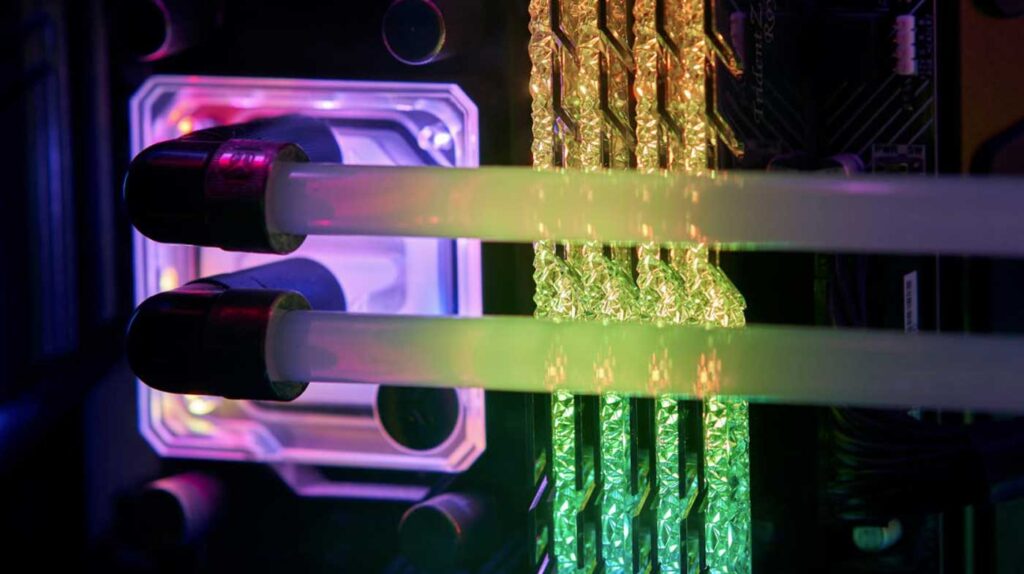
As data centers evolve to handle the staggering power demands of high-density AI, machine learning, and high-performance computing (HPC), the industry is hitting a “thermal wall.” Traditional air cooling is often no longer sufficient for chips exceeding 300W–500W. The solution is the widespread adoption of liquid cooling—specifically Single-Phase Immersion and Direct-to-Chip (Cold Plate) systems.
However, moving from air to liquid introduces a completely different set of contamination risks. In a liquid environment, “dust” is no longer the primary enemy; instead, we face chemical leaching, bio-fouling, and mineral scaling. Maintaining these systems requires a transition from janitorial thinking to laboratory-grade precision.
1. The Chemistry of Immersion: Managing Dielectric Integrity
In single-phase immersion cooling, the entire server is submerged in a non-conductive, dielectric fluid (typically a synthetic hydrocarbon or fluorinated liquid). While this fluid is designed to be chemically inert, it acts as a solvent over time.
The Material Compatibility Crisis
Every component on a server—ribbon cables, labels, adhesives, and solder masks—was originally designed for air. When submerged, these materials can undergo plasticizer leaching.
-
What happens: The chemicals used to make cable jackets flexible “bleed” into the dielectric fluid.
-
The Result: The fluid becomes cloudy (loss of optical clarity) and, more importantly, its viscosity can change, reducing its ability to transfer heat effectively. In extreme cases, these leached solids can settle on the surface of chips, creating an insulating layer that leads to “hot spots.”
Protocol: Fluid Polishing and Filtration
Cleaning an immersion tank isn’t about wiping surfaces; it’s about fluid restoration.
-
Kidney-Loop Filtration: Use a mobile filtration unit to pull fluid from the tank, pass it through a sub-micron particulate filter and a chemical absorption bed, and return it to the tank.
-
Particulate Monitoring: Much like air-particle counting, fluid should be tested for “total suspended solids” (TSS).
-
Refractometry: Regularly check the refractive index of the fluid to ensure the chemical composition hasn’t been altered by leached contaminants.
2. Direct-to-Chip (Cold Plate) Systems: The Secondary Loop
Cold plate systems use a Closed-Loop-Cooling (CLC) architecture where liquid (usually water or a water-glycol mix) is pumped directly to a copper plate sitting on the CPU/GPU.
The Bio-Fouling Threat
Warm water is a breeding ground for life. Even in a closed system, microscopic bacteria and algae can find their way in during installation or maintenance.
-
The Biofilm Barrier: Bacteria create a “slime” or biofilm on the interior walls of the micro-channels inside the cold plate.
-
Thermal Degradation: Biofilm is an incredibly poor conductor of heat. Even a layer just a few microns thick can cause a chip to throttle, defeating the entire purpose of the liquid system.
The Mineral Scaling Problem
If “hard” water or improperly treated coolant is used, minerals like calcium and magnesium will precipitate out of the liquid and “plate” onto the hottest surfaces—the cold plates. This acts exactly like the scale in a teapot, eventually clogging the tiny fins (micro-channels) and stopping fluid flow entirely.
3. The “Clean-Break” Maintenance Protocol
Maintaining liquid-cooled racks requires a “clean-break” mentality to prevent the introduction of contaminants when a server needs to be serviced.
Dripless Quick Connectors (DQCs)
The most vulnerable moment for a liquid-cooled system is the “hot-swap.” DQCs are designed to seal the loop when a server is pulled, but they are not infallible.
-
Cleaning the Interface: Before reconnecting a server to the manifold, the DQC faces must be cleaned with 99.9% Isopropyl Alcohol (IPA) using a lint-free swab. A single speck of grit can damage the O-ring, leading to a slow, “silent” leak that may go unnoticed for weeks.
The “Dry-Zone” Wipe Down
When a server is pulled from an immersion tank, it is dripping with fluid.
-
The Error: Using standard paper towels or shop rags. These shed thousands of fibers that will contaminate the fluid when the server is re-submerged.
-
The Standard: Use Class 100 (ISO 5) cleanroom wipes. These are continuous-filament polyester wipes that are “sealed-edge” to ensure zero fiber shedding.
4. Spill Remediation and Safety
While dielectric fluids are non-conductive, they are incredibly slippery and can be difficult to remove from floor surfaces.
-
Non-Aqueous Spills: Traditional mopping only spreads dielectric fluid. Specialized hydrophobic absorbents (which soak up oils/fluids but repel water) must be used.
-
The Residue Problem: After a spill is absorbed, the floor must be cleaned with a specialized degreaser to restore the “Coefficient of Friction” (COF). A data center floor with a dielectric film is a massive slip hazard for technicians.
Conclusion: Data Center Hygiene as a Chemical Science
As we move toward a liquid-cooled future, the definition of “clean” is shifting. It is no longer enough for a facility to look clean to the naked eye. In the world of immersion and cold plates, cleanliness is measured in chemical purity, fluid viscosity, and microbial counts.
By implementing a rigorous “Liquid Hygiene Protocol”—focusing on material compatibility, fluid polishing, and DQC maintenance—operators can ensure that their high-density clusters deliver the performance they were designed for, without the risk of silent, liquid-borne failure.